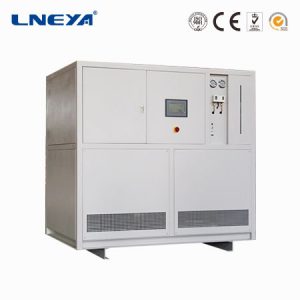
Refrigeratori industriali LNEYA Produttore Fornitore


Cooling and heating of the reactor and the principle of use
Cooling and heating circulator thermostats are commonly used with glass reactors for biochemical instruments. They are widely used in modern fine chemicals, biopharmaceuticals, scientific research and experiment industries. They can be concentrated, distilled, Will stay, separate and purify the reaction. In the production process, whether it is a double-layer glass reactor or a single-layer glass reactor, the refrigeration heating temperature control system can generally complete high temperature, low temperature, and vacuum reaction experiments at the same time. Under constant temperature conditions, in a closed container, the refrigerating and heating circulator can be combined with a glass reactor to carry out stirring and reaction under normal or negative pressure, and can control the evaporation and reflux of the reaction solution.
One of the methods of obtaining high temperature is steam heating. When the cooling and heating temperature control system is matched with the glass reactor, the heating temperature is required to be below 100°C, and the glass reactor can be heated by steam. In this method, the equipment is heated with subatmospheric steam. When the temperature is required to be in the range of 100°C to 180°C, saturated steam can be used; when the temperature is required to be higher, high-pressure superheated steam can be used for heating.
Different manufacturers’ isolation reactor heating circulators are designed with different temperature ranges and media. It is necessary to select the appropriate media according to the available media of the equipment. Common media include water, oil, refrigerant, etc. The cooling process of the equipment is to use the refrigerant to absorb the excessive heat of the equipment and evaporate it to achieve the purpose of temperature difference.
The principle of temperature control of the matching reactor is indirect temperature control. The temperature is controlled by the heat transfer oil or other medium in the jacket of the reactor and the coil, and the temperature of the reactor wall is raised and lowered through the medium.
Our LNEYA heating circulator can set the working temperature and alarm temperature on the equipment digital display, press the heating option, after the indicator light is on, you can adjust its heating power through power selection; when using heat transfer oil, it is recommended to directly contact the equipment The manufacturer purchases the corresponding heat transfer oil. When using it, the heat transfer medium cannot contain water, otherwise it will cause equipment failure.
Raccomandazioni correlate
-

Scelta del refrigeratore a bassissima temperatura per il reattore in vetro
1522Per ottenere un ambiente economico a bassissima temperatura per i reattori in vetro, molti clienti non scelgono apparecchiature di refrigerazione a compressore multistadio con più di due stadi, ma utilizzano l'azoto liquido. Il costo dell'azoto liquido...
Visualizza dettagli -
Descrizione dettagliata delle tubazioni delle apparecchiature del ciclo di refrigerazione e riscaldamento
1773When the refrigeration and heating cycle equipment is in operation, the user will find that whether or not the fully enclosed pipeline affects the overall performance. The LNEYA refrigeration and heating cycle equipment adopts a fully enclosed cyc...
Visualizza dettagli -
Suggerimenti sul marchio del congelatore a bassissima temperatura
1368Quando si parla di congelatore a bassissima temperatura, la maggior parte delle persone si preoccupa perché la temperatura ultra bassa significa che la tecnologia diventa più impegnativa. Rispetto ad altri impianti di refrigerazione, le scelte del congelatore a bassissima temperatura...
Visualizza dettagli -
Perché i refrigeratori di glicole etilenico possono essere utilizzati per le reazioni di polimerizzazione e accoppiamento
13401. Riscaldamento della polimerizzazioneGeneralmente, le materie prime della reazione di polimerizzazione sono alcuni solventi infiammabili, e il riscaldamento rapido può causare una temperatura locale troppo elevata e provocare incidenti. Ogni reazione di polimerizzazione ha il suo...
Visualizza dettagli