Refrigeratori industriali LNEYA Produttore Fornitore


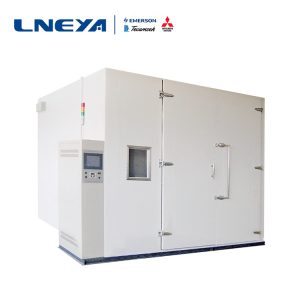
Comparison of Three Test Methods for Low Temperature Chamber
1. Existence and absence of forced air test for heat dissipation test samples
The method of guaranteeing the fluctuation of uniformity in high and low temperature test box is to adopt the wind circulation mode, in which the motor drives the fan to produce the wind circulation, thus forming the direction of wind speed. Non-forced air circulation test is a kind of test to simulate the influence of free air conditions, which is more suitable for the test of heat dissipation test samples. When forced air circulation is not used or test conditions are not guaranteed, forced air circulation can be used. One of the methods used in the test chamber is large enough to meet the test requirements without forced air circulation, but the required low temperature can not be maintained without forced air circulation in the chamber. Forced air circulation is required for refrigeration or heating of camera a bassa temperatura.
The method of guaranteeing the fluctuation of uniformity in high and low temperature test box is to adopt the wind circulation mode, in which the motor drives the fan to produce the wind circulation, thus forming the direction of wind speed. Non-forced air circulation test is a kind of test to simulate the influence of free air conditions, which is more suitable for the test of heat dissipation test samples. When forced air circulation is not used or test conditions are not guaranteed, forced air circulation can be used. One of the methods used in the test chamber is large enough to meet the test requirements without forced air circulation, but the required low temperature can not be maintained without forced air circulation in the chamber. Forced air circulation is required for refrigeration or heating of camera a bassa temperatura.
2. Non-heat dissipation test samples and heat dissipation test samples
When the temperature of the test sample is stable during the conditional test period, the hottest spot temperature on the surface of the test sample is higher than the ambient atmospheric temperature by 5 degrees under the condition of free air, which is considered to be heat dissipation, whereas the non-heat dissipation test sample is considered to be heat dissipation. All the storage test and the test period without power or load, the test samples are non-heat dissipation test samples, the test using low temperature test method.
3. Non-heat dissipation test samples
Temperature gradient test of low temperature chamber(the former is a rapid temperature change test box and the latter is a cryogenic tester).
(1) Temperature gradient test: first, test samples with room temperature are put into the same room temperature test box. Then turn on the cold source to gradually cool the temperature in the box to the specified test temperature. If the test sample is too large or too heavy, or because of the complex functional test wiring, it can not be put into the cryogenic chamber without frosting in the catastrophe test, the test should also be used.
(2) Temperature catastrophe test: first adjust the temperature of the test chamber to the specified test temperature, and then put the test sample with room temperature. This test method is applicable when the known temperature abrupt change does not produce operation on the test sample.
Raccomandazioni correlate
-

How to eliminate the failure of large thermal shock test chamber?
1527As technology continues to advance and improve, LNEYA recommends strict requirements for operators of large thermal shock test chambers. If used improperly, operators need to be able to face and resolve these problems in a timely manner. A large t...
Visualizza dettagli -
Quali sono gli interventi di manutenzione dei refrigeratori a glicole nel funzionamento quotidiano?
1744Nel funzionamento quotidiano del refrigeratore di glicole, se non viene effettuata la manutenzione, l'effetto di raffreddamento sarà ridotto. Pertanto, per migliorare l'efficienza operativa, si consiglia di eseguire la necessaria manutenzione quotidiana. Refrigeratore...
Visualizza dettagli -
Quali aspetti devono essere considerati nel sistema di raffreddamento a circolazione esterna del banco di prova?
1609Come tutti sappiamo, la sala prove deve essere dotata di un sistema di raffreddamento per le prestazioni del veicolo e di un sistema completo di trasmissione, simulazione stradale, compatibilità elettromagnetica, batteria di alimentazione, ambiente del veicolo e altri test.
Visualizza dettagli -
Aspects to be aware of when using an air-cooled all-in-one
1354The air-cooled all-in-one is in operation, unless it is necessary, please do not open the chassis door, otherwise the following adverse consequences may result. When the equipment is subjected to a high temperature test, it is very dangerous to bl...
Visualizza dettagli