Refrigeratori industriali LNEYA Produttore Fornitore


Function of Evaporator in Air Cooled Chiller
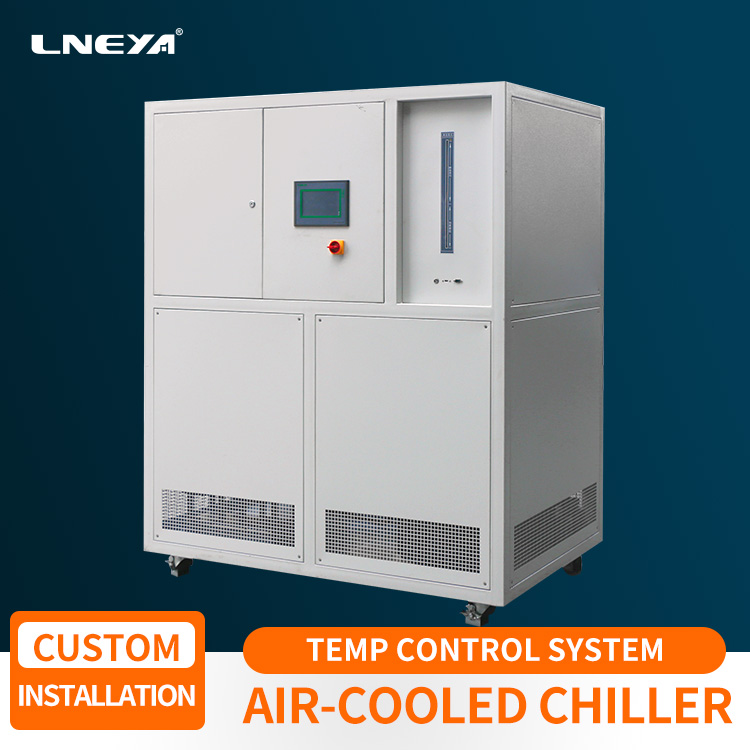
The air-cooled chiller adopts the air cooling mode, which eliminates the essential cooling tower, cooling water pump and pipeline system of the cooling water system, avoids the condenser scaling and water pipe blockage in areas with poor water quality, and saves water resources. It is the most economical and simple machine for maintenance and repair in the current refrigeration equipment. The one-time investment of air-cooled chiller is slightly higher than that of water-cooled chiller, but the annual operation cost is lower than that of water-cooled chiller. The construction cost of machine room is the least among various cold and heat source systems, and the maintenance cost is about half of that of water-cooled chiller.
When the temperature of air or other fluid decreases, the pressure in the temperature sensing bag decreases. The valve port of the temperature control pilot valve is closed, and the refrigerant gas flow from the evaporator to the main regulating valve decreases. When the pressure at the top of the main piston is discharged into the suction pipe of the compressor, the main spring closes the main valve. In the air-cooled chiller system, when the evaporator pressure regulating valve is used to control the temperature, the temperature control pilot valve should be used to replace the pressure control pilot valve introduced earlier, so that the temperature of air or other fluids flowing through the evaporator can be accurately maintained at a predetermined value.
The evaporator is one of the four major components in the chiller system. The evaporator plays a role in heat dissipation in the chiller system. Connect the temperature control pilot valve with the joint of the outer pressure guide hole of the evaporator pressure regulating valve, and place the temperature sensing package of the pilot valve in the air flow or flowing medium to control its temperature. When the temperature of air or other medium increases, the pressure in the temperature sensing package increases, and the valve port of the temperature control pilot valve opens, so the evaporator pressure is transmitted to the space at the top of the main regulating valve piston through the outer pressure guide pipe, Press down the piston and open the main regulating valve. The evaporator pressure then drops to an appropriate value, which increases the temperature difference between air or other fluids and refrigerant, and improves the refrigeration capacity of the evaporator of the low-temperature chiller.
Raccomandazioni correlate
-

Principio di analisi del funzionamento del circolatore di riscaldamento a refrigerazione
1672Con il continuo sviluppo della tecnologia, sempre più apparecchiature di refrigerazione sono apparse nella nostra vita, come ad esempio i circolatori di refrigerazione e di riscaldamento, che in realtà non sono ordinari, sono apparecchiature di refrigerazione notevoli. La refrigerazione...
Visualizza dettagli -
How to troubleshoot the failure of the material aging test chiller?
1718Regular maintenance work for the material aging test chiller, and troubleshooting is also very important. 1. Exhaust at double high pressure, heat dissipation may be problematic. When it is detected that the high and low pressure of the system are...
Visualizza dettagli -
Product description for ultra-low temperature refrigeration
1505Technical parameters (low temperature cold storage project within 100 cubic meters) of Ultra-Low Temp Cold Storage 1. Medical cold storage temperature range(℃):Low-temperature storage library: -20°C to -50°C Preservation of plasma, biological ma...
Visualizza dettagli -
Dynamic and accurate temperature simulation for test benches in the automotive industry
1408Quality and safety testing are the core elements of the overall development and production process of the automotive industry. With KRY-475 and 455 process cooling circulators, we provide customers with a perfect temperature control solution for p...
Visualizza dettagli